If this is your first visit, be sure to
check out the FAQ by clicking the
link above. You will have to register
before you can post: click the register link above to proceed. To start viewing messages,
select the forum that you want to visit from the selection below.
Welcome to the Shaolin Wahnam Institute Virtual Kwoon and Discussion Forum.
You are currently viewing our boards as a guest which gives you limited access to view most discussions and access our other features. By joining our free community you will have access to post topics, communicate privately with other members (PM), respond to polls, upload content and access many other special features. Registration is fast, simple and absolutely free.
When considering joining our community, please read our Forum Rules and FAQ. Please also note that this forum, although open to the public, is actually a virtual extension of the Shaolin Wahnam Kwoon (Martial Arts School). Upon "entering" the school, we do expect our guests and members to conduct themselves in an appropriate manner at all times.
If you have any problems with the registration process or your account login, please contact us.
Please follow this link to find out what a Virtual Kwoon is.
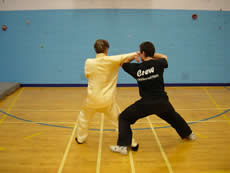
I assume this is the technique you're referring to?
You can't really tell much from a picture... You can't tell intent, speed, power etc...
This pic from our training point of view... a totally different style is a bad position to be in. If I wanted to seriously hurt the person I would step down right behind the knee while snapping the arm all in the same motion. Or if I did not want to seriously injure them I could sweep the leg and simply push in the other direction.
The problem with this pic is you don't know the intent... You should never be caught with your arm extended like that in the first place though... I'd also recommend using the hand on the joint over the elbow... the elbow puts you too close to your opponent. He's already inside for any follow up techniques...
Last edited by hakfudisciple; 14 August 2010, 04:12 PM.
You can't really tell much from a picture... You can't tell intent, speed, power etc...
Hey Jeff,
Have you watched the video yet? I would be curious to hear your thoughts after watching the video. Some of the details are done differently in the video than the picture which make the technique both safer for the attacker and more nasty for the defender. However, in the video, the intent is not malicious as it is cooperative sequence sparring and they had just recently learned some of the techniques (I believe).
In terms of some of your comments, though:
This pic from our training point of view... a totally different style is a bad position to be in.
I disagree. While this is not the most devastating position to be in with this technique (the application shown in the video is more devastating) it is in no way a bad position. The attacker is well protected and can easily respond to the likely counters. He also has the option of breaking/dislocating his opponent's elbow simply by changing to a right bow stance.
If I wanted to seriously hurt the person I would step down right behind the knee while snapping the arm all in the same motion. Or if I did not want to seriously injure them I could sweep the leg and simply push in the other direction.
We typically learn the basics of the pattern first, and then gradually add more subtleties. So first we would learn the standard mode/application, and then only after taking it to a relatively high level would we add additional layers of complexity as the situation warranted. Also, it depends on what type of sparring the pictures/videos come from. If you're familiar with our methodology, you know we have pre-arranged sequences to train both skills and techniques, and adding some of those other details (like kicking the knee out or sweeping the leg) will often cause the need for a different counter. Deeper in the sparring progression, this is great as it brings the techniques to life. Earlier on, though, this can put a wrench in the works and throw the sequence off. So it depends on the objectives of the sparring session whether or not this would be done.
The problem with this pic is you don't know the intent...
While I don't see it as a problem, I agree that you cannot be 100% certain of the intent of both parties. I'm fairly certain, though, that Ronan does not have the intent of actually dislocating Sigung's arm, and that Sigung is allowing Ronan to apply the technique.
You should never be caught with your arm extended like that in the first place though...
Ideally (for the responder) one would not end up in the position with the arm extended and the joint locked. However, depending on the level or emotional state of your opponent, it is possible through the use of proper tactics and strategies to catch him or force him into that position and take advantage of it with fierce tiger breaks flank.
I'd also recommend using the hand on the joint over the elbow... the elbow puts you too close to your opponent. He's already inside for any follow up techniques...
Depending on the situation (someone trying to grapple with you would be one of many examples) the elbow can offer much more leverage and control than the hand. When executed correctly, this pattern is very safe and very well covered - once you have the elbow, there is only one direction for your opponent to go (assuming you chose not to dislocate his elbow) so the responses you have to defend against are pretty limited.
As this is one of the patterns I have been working on recently, I'm really interested in more of your thoughts on it.
Have you watched the video yet? I would be curious to hear your thoughts after watching the video. Some of the details are done differently in the video than the picture which make the technique both safer for the attacker and more nasty for the defender. However, in the video, the intent is not malicious as it is cooperative sequence sparring and they had just recently learned some of the techniques (I believe).
Thanks for the link I had not seen the clip... I might not be getting my point across when I say intent. I was trying to state that I didn't know what was the intent of the technique or counter from the picture.
In terms of some of your comments, though:I disagree. While this is not the most devastating position to be in with this technique (the application shown in the video is more devastating) it is in no way a bad position. The attacker is well protected and can easily respond to the likely counters. He also has the option of breaking/dislocating his opponent's elbow simply by changing to a right bow stance.We typically learn the basics of the pattern first, and then gradually add more subtleties. So first we would learn the standard mode/application, and then only after taking it to a relatively high level would we add additional layers of complexity as the situation warranted. Also, it depends on what type of sparring the pictures/videos come from. If you're familiar with our methodology, you know we have pre-arranged sequences to train both skills and techniques, and adding some of those other details (like kicking the knee out or sweeping the leg) will often cause the need for a different counter. Deeper in the sparring progression, this is great as it brings the techniques to life. Earlier on, though, this can put a wrench in the works and throw the sequence off. So it depends on the objectives of the sparring session whether or not this would be done.
There really is no wrong or right here because we train different styles and what might be advantageous to you might be a disadvantage to me or vice versa... I think this helps because it gives you a vision how different styles look at the same scenario with different eyes. I wasn't speaking in terms of being devastating with the technique I was saying you could use the hand to break the elbow joint over the elbow which he's using in the pic and video clip. Using the elbow IMO opens a whole new can of worms... It's a beginning sequence you say...so maybe once more is learned about the technique the counters will be covered. Black Tiger is an in close fighting system so I see things that others may not....
While I don't see it as a problem, I agree that you cannot be 100% certain of the intent of both parties. I'm fairly certain, though, that Ronan does not have the intent of actually dislocating Sigung's arm, and that Sigung is allowing Ronan to apply the technique.Ideally (for the responder) one would not end up in the position with the arm extended and the joint locked. However, depending on the level or emotional state of your opponent, it is possible through the use of proper tactics and strategies to catch him or force him into that position and take advantage of it with fierce tiger breaks flank.Depending on the situation (someone trying to grapple with you would be one of many examples) the elbow can offer much more leverage and control than the hand. When executed correctly, this pattern is very safe and very well covered - once you have the elbow, there is only one direction for your opponent to go (assuming you chose not to dislocate his elbow) so the responses you have to defend against are pretty limited.
As this is one of the patterns I have been working on recently, I'm really interested in more of your thoughts on it.
All the best,
Yes, lol.. I'm sure your sigung allowed him to have that position... I was not saying otherwise. You have to bare with me I'm not the best at putting my thoughts into words while typing.
The problem I see with the elbow is it puts you into the attackers range and looking at the body position used in both the pic and video clip you've just opened yourself up to a counter attack that would be avoided if you used the hand and kept the distance between yourself and your attacker. Not to mention IMO there is too much wasted movement going on but, again you said it's a beginning sequence so I can see it being trained that way...
We train a bit differently than most CMA schools I've ever attended. My sifu looks at everything from self defense/fighting only! No matter if you're beginning or advanced you're going to get the best technique with the shortest most effective method. I don't knock anything you guys are doing so please don't misunderstand my intentions. I'm just trying to offer a different view from a different system.
I don't knock anything you guys are doing so please don't misunderstand my intentions. I'm just trying to offer a different view from a different system.
No worries. You've always been respectful on the forum even when your opinions differed from members of our school. In the areas I disagree with you, it's because I disagree with what is written, and not because I feel you are attacking Shaolin Wahnam.
Yes, lol.. I'm sure your sigung allowed him to have that position... I was not saying otherwise. You have to bare with me I'm not the best at putting my thoughts into words while typing.
Lol. Well that's an area we can both use improvement in, then.
There really is no wrong or right here because we train different styles and what might be advantageous to you might be a disadvantage to me or vice versa...
Fair enough.
I might not be getting my point across when I say intent. I was trying to state that I didn't know what was the intent of the technique or counter from the picture.
Gotcha. I would probably call that the application of the pattern, not the intent. Intent in my mind goes more toward the mental state/intention of the practitioners themselves while executing the applications. Either way, are you still unclear about the application/intent of the pattern or counter after watching the video?
I think this helps because it gives you a vision how different styles look at the same scenario with different eyes.
A different perspective is very often useful. Would you be willing to share how your vision of this is different? So far I all I'm getting is that you feel the hand on the elbow is safer than the elbow because it gives you more space between you and your opponent. After being on both the giving and receiving end of this pattern, I'm failing to see where this glaring weakness is that opens me "up to a counter attack that would be avoided if you used the hand."
There are also some significant advantages to using the elbow for a break instead of the hand. This advantage is magnified the closer you get to your opponent which is why I find it surprising for you to disapprove of the elbow as an in close breaking technique.
Fair enough. Gotcha. I would probably call that the application of the pattern, not the intent. Intent in my mind goes more toward the mental state/intention of the practitioners themselves while executing the applications. Either way, are you still unclear about the application/intent of the pattern or counter after watching the video?
yeah application would be more proper... I see the application and the intent lol
I have a problem with the entire sequence.... But, the sequence is there for a reason in your training.
A different perspective is very often useful. Would you be willing to share how your vision of this is different? So far I all I'm getting is that you feel the hand on the elbow is safer than the elbow because it gives you more space between you and your opponent. After being on both the giving and receiving end of this pattern, I'm failing to see where this glaring weakness is that opens me "up to a counter attack that would be avoided if you used the hand."
Well, It's a bit difficult to totally explain but, I'll try. First off the initial attack is open to many counters itself... On the initial block he could've blocked and swept the attackers lead leg or used his stance to take the attacker down all in one motion. The actual grabbing and breaking of the limb... Is a technique that is not likely to work on a fully resisting opponent. Even in the set up of the break the person being attacked need only to sink the elbow and it takes away the break altogether. By sinking the elbow I eliminate the follow up moves of that sequence. The step in and over is based off the elbow break but, by sinking the elbow I avoid that and the following step over would be very risky to the attacker... as he's now offering his side/back to attack with him being defenseless to counter. That is one counter...
Another counter...
On the initial attack the person being attacked could step back and stop kick the lead leg or step down on the knee. He could block as he does and right after the block use a snake strike to the throat side of neck, sternum etc... We rarely block and then strike our blocks are blocks and strikes all in one avoiding wasted movement. I'm not sure if you can follow what I'm saying?
There are also some significant advantages to using the elbow for a break instead of the hand. This advantage is magnified the closer you get to your opponent which is why I find it surprising for you to disapprove of the elbow as an in close breaking technique.
I'm looking forward to your response.
Sincerely,
I disapprove because you don't want to put yourself in certain situations/positions even though... we are adapt at fighting in close. The idea is to keep the attacker to the outside of your attack. By doing this every counter must come across their body which is very easily countered with very little effort. In the video clip the guy is already inside which is where you never want your attacker to be. If they get inside we have to counter and gain position again.
By sinking the elbow I eliminate the follow up moves of that sequence.
By lowering the elbow the face is now exposed to a strike to the eyes. Very easy for the attacker to change the flow of the attack from the elbow break to a palm-up thrust over the lowered elbow. The counter shown in the video is much safer (although requiring considerable skills to execute...).
First off the initial attack is open to many counters itself... On the initial block he could've blocked and swept the attackers lead leg or used his stance to take the attacker down all in one motion.
Another counter...
On the initial attack the person being attacked could step back and stop kick the lead leg or step down on the knee. He could block as he does and right after the block use a snake strike to the throat side of neck, sternum etc...
Yes, there are literally countless ways that different parts of this sequence could be handled. I also get that you are not a big fan of our sparring methodology. This is of course fine and I would be happy to have a conversation about that as well. Neither of these issues are really on the current topic, though. I think it would be more productive to keep this discussion targeted towards the application and defense of Black Tiger Breaks Flank.
The actual grabbing and breaking of the limb... Is a technique that is not likely to work on a fully resisting opponent.
Now we're talking! As I mentioned before, tactics and strategies are an important component of Chin Na. In order for this pattern to work, you have to get your opponent into a position which is advantageous for you.
Even in the set up of the break the person being attacked need only to sink the elbow and it takes away the break altogether. By sinking the elbow I eliminate the follow up moves of that sequence. The step in and over is based off the elbow break but, by sinking the elbow I avoid that and the following step over would be very risky to the attacker... as he's now offering his side/back to attack with him being defenseless to counter. That is one counter...
Agreed.
There are three points to counter Chin Na: initial, mid, and end-point. This example is what we call an initial point counter. The attacker would be foolish to continue to try and force the technique at this point (stepping in and turning his back). A good Chin Na exponent would flow from his initial plan into some other technique (like the one George mentioned) if someone implemented an initial point defense such as this.
However, an initial point defense makes a rather large assumption - that the defender saw through the tactics of the attacker well in advance. To assume that one would never be tricked by the tactics of his opponent is a foolish assumption. So, for the sake of discussion, let's assume that through proper tactics, your skilled opponent caught you overextended and applied Breaking Flank. You are now in the mid/end-point of the application. What would your response be? Also, in this position, would you still feel that the pattern is inherently exposed due to the closeness of the elbow?
The idea is to keep the attacker to the outside of your attack.
I'm not really sure what you mean by this. Outside would mean different things in different contexts. For example, we have the outside gate and inside gate when entering. Outside gate would be closing the opponent's arm toward his body and inside gate would be opening his arms up. For example, the initial attack in the video uses inside gate.
Or are you referring to the end of your technique and keeping them at arm's length?
Only a small comment, as I've never actually been taught Sequence 20 and its applications...
By lowering the elbow the face is now exposed to a strike to the eyes. Very easy for the attacker to change the flow of the attack from the elbow break to a palm-up thrust over the lowered elbow. The counter shown in the video is much safer (although requiring considerable skills to execute...).
Fact is lowering the elbow also opens up the attackers face as well... I could easily sink the elbow and withdraw It while following up with a eye or throat strike of my own.... with the other hand snaking in over the withdrawing hand.
However, an initial point defense makes a rather large assumption - that the defender saw through the tactics of the attacker well in advance. To assume that one would never be tricked by the tactics of his opponent is a foolish assumption.
On what you refer to as the initial point... It's not an assumption on my part. I can understand your point and you would be right! My sinking of the elbow is an automatic response to a grab the elbow would already be slightly bent during my strike... (It's something we train constantly to keep the elbow slightly bent) We train this to avoid being caught extended.
So, for the sake of discussion, let's assume that through proper tactics, your skilled opponent caught you overextended and applied Breaking Flank. You are now in the mid/end-point of the application. What would your response be? Also, in this position, would you still feel that the pattern is inherently exposed due to the closeness of the elbow?
At the mid point I would still attempt to sink or slightly bend the elbow while placing my free hand against the shoulder blade... by doing this it gives the arm support and also helps to keep the shoulder from being dislocated. Now the next move I can't say for sure what the follow up would be... I could either sink into a horse stance or shift into a bow and arrow stance and try to drive my shoulder into the attacker to provide myself some space.
I'm not really sure what you mean by this. Outside would mean different things in different contexts. For example, we have the outside gate and inside gate when entering. Outside gate would be closing the opponent's arm toward his body and inside gate would be opening his arms up. For example, the initial attack in the video uses inside gate.
Or are you referring to the end of your technique and keeping them at arm's length?
As always, I'm looking forward to your thoughts.
Lets see if I can explain this...
If you attack me with let's say a straight right punch.... my response is to attack or deflect from the outside of the attacking arm. So I would use my left arm to deflect the strike across from left to right... by doing this I'm staying away from your power and any counter by you would have to come from your left arm, which would require you to throw across your body. I could easily trap and counter any technique you attempt if you don't with draw first. You'd have to withdraw to have any chance of attacking me with any type of power.
What we train is totally different from what I just explained though... In reality I'd step at a 45 degree angle and shoot my left arm across your strike between the forearm and elbow. What that does is put me out of your reach back across your body and I've countered and attacked you all in one while using only one arm... We train to attack the attack with our own attack so basically our attack is our block.
Last edited by hakfudisciple; 18 August 2010, 10:50 AM.
On what you refer to as the initial point... It's not an assumption on my part.
Good.
I can understand your point and you would be right! My sinking of the elbow is an automatic response to a grab the elbow would already be slightly bent during my strike... (It's something we train constantly to keep the elbow slightly bent) We train this to avoid being caught extended.
These are excellent habits to minimize the likelyhood of getting caught with this technique. This doesn't necessarily mean that you wouldn't ever be in this position, however. I'll explain what I mean in the answer to your counter below.
At the mid point I would still attempt to sink or slightly bend the elbow while placing my free hand against the shoulder blade... by doing this it gives the arm support and also helps to keep the shoulder from being dislocated. Now the next move I can't say for sure what the follow up would be... I could either sink into a horse stance or shift into a bow and arrow stance and try to drive my shoulder into the attacker to provide myself some space.
Jeff, I think you're underestimating the difficulty in sinking the elbow when this technique is being applied correctly. You don't really see it in the video, but when it's applied, the grip on the right hand is pulling the right hand away from the body as well as torquing it in a spiraling direction against the fulcrum of the left elbow. If this force was only being applied by the attacker's arm you could simply bend your elbow. However, when done correctly the pulling force comes from the spiraling movement of rotating into the right bow. So, the strength of the attacker's whole body is pulling the arm in a clockwise rotation, away from the body, and downwards, while applying upward pressure with the left elbow. Sinking the elbow isn't realistic once the pattern is past the initial-point. For now, I'm going to leave out the vital point gripping of the right hand. I currently don't have the force or skill to apply it with this pattern, so I don't know from experience how it changes the ability to counter. Maybe a couple years down the road we can continue this discussion with an added layer of depth.
In terms of placing your left hand on the left scapula of the opponent, this is excellent. Moving your left hand across your body and bringing it to the opponent's shoulder forces you to turn your upper body in a clockwise direction. This is flowing with the momentum of the attack which is necessary against good chin na.
This flowing with the momentum is the basis of the counter shown in the video. You can see in the video that he also moves up to release the pressure and flows around the technique with his whole stance. In my opinion, following the clockwise momentum and attacking from an angle is by far the most reliable counter.
Lets see if I can explain this...
If you attack me with let's say a straight right punch.... my response is to attack or deflect from the outside of the attacking arm. So I would use my left arm to deflect the strike across from left to right... by doing this I'm staying away from your power and any counter by you would have to come from your left arm, which would require you to throw across your body. I could easily trap and counter any technique you attempt if you don't with draw first. You'd have to withdraw to have any chance of attacking me with any type of power.
What we train is totally different from what I just explained though... In reality I'd step at a 45 degree angle and shoot my left arm across your strike between the forearm and elbow. What that does is put me out of your reach back across your body and I've countered and attacked you all in one while using only one arm... We train to attack the attack with our own attack so basically our attack is our block.
Thank you for the detailed explanation. We would refer to this strategy as using the tactic of attacking from the outside gate combined with the tactic no defense direct counter/defense cum counter.
I am also still curious as to the question I asked earlier: do you feel that this pattern in inherently overexposed with the additional information on how it is applied?
These are excellent habits to minimize the likelyhood of getting caught with this technique. This doesn't necessarily mean that you wouldn't ever be in this position, however. I'll explain what I mean in the answer to your counter below.
You are correct!
But, you'd be surprised at how much a small sinking of the elbow can nullify even such a devastating technique as the break were speaking of. You'd have to experience the extreme wrist and arm conditioning we do in our training to fully understand my view.
But, to address your point... even with all the training in the world it's possible to still get caught. Once the arm is caught I can still brace the shoulder to support the arm a little. That doesn't mean it will stop the break though... The only counter I see at this point would be to step down on the back of the crossing leg... The problem I see with any grab is that they are easily broken by simple movements when tested against resisting opponents. No matter how strong the grab you can either go soft and break the grab or you can usually slightly shift the arm or elbow and dislodge the grab. It's the reason you don't see standing type locks applied. In most cases a simple twisting down and inward while slightly chambering the arm would be enough to break most grabs.
Jeff, I think you're underestimating the difficulty in sinking the elbow when this technique is being applied correctly. You don't really see it in the video, but when it's applied, the grip on the right hand is pulling the right hand away from the body as well as torquing it in a spiraling direction against the fulcrum of the left elbow. If this force was only being applied by the attacker's arm you could simply bend your elbow. However, when done correctly the pulling force comes from the spiraling movement of rotating into the right bow. So, the strength of the attacker's whole body is pulling the arm in a clockwise rotation, away from the body, and downwards, while applying upward pressure with the left elbow. Sinking the elbow isn't realistic once the pattern is past the initial-point. For now, I'm going to leave out the vital point gripping of the right hand. I currently don't have the force or skill to apply it with this pattern, so I don't know from experience how it changes the ability to counter. Maybe a couple years down the road we can continue this discussion with an added layer of depth.
I see the rotation you're speaking of and I'm looking at the technique over and over again every time we discuss it... The problem with this technique is in the last part of your statement...
As I addressed in the other paragraph... It requires a lot of strength to be able to grab and control someone from the wrist, even with the shift into bow stance and the torquing. The problem with that logic is it doesn't require much strength at all to break most grabs. In theory it makes sense the problem with most CMA techniques today is they're stuck in the theory phase!
Now take into account that most grabs are easily broken and add that the person being grabbed has conditioned wrist?
I am also still curious as to the question I asked earlier: do you feel that this pattern in inherently overexposed with the additional information on how it is applied?
I think the opening sequence as it appears in the video is exposing the attacker to serious counter attack IF, he's not extremely comfortable being in that close. I for one would respond to the initial attack by attacking his stance. I'd lock my shin against his while sinking into bow stance...(during the sinking into bow you slide the tip of your foot behind his heal...preventing him from withdrawing the foot.) this puts a lot of pressure on his shin and ankle. He has to counter with his stance or risk having his ankle snap under the pressure. This is where fighting with your stance comes into play. Most people knock spending lots of time sitting in horse stance but it really comes in handy when you fight with your legs.
Last edited by hakfudisciple; 18 August 2010, 07:00 PM.
Excellent.
I also get that you are not a big fan of our sparring methodology. This is of course fine and I would be happy to have a conversation about that as well.
I don't agree with the sparring but I actually enjoy watching it!
I see it like this... If it works who cares how I or anyone else feels about it?
I get knocked on our hr long horse stance training all the time... I'm not going to change a thing though!
But, you'd be surprised at how much a small sinking of the elbow can nullify even such a devastating technique as the break were speaking of.
Yes, slight changes in the angle of the arm can thwart a lot of locking techniques.
You'd have to experience the extreme wrist and arm conditioning we do in our training to fully understand my view.
This is true. The issue I have with this, though is that it assumes your force is greater than that of your opponent. If someone is skillful enough to apply this type of technique successfully, he likely also has years of specialized gripping training as well. Your wrist conditioning may be grater than the grip conditioning of your opponent, and it may not. To me it makes sense to have counters that are still effective even if your opponent has more force than you do.
The only counter I see at this point would be to step down on the back of the crossing leg...
Applying downward force at this point would only accentuate the break. This is why in the counter shown he flows up and over the elbow; you can't go down through it. This is one of the main advantages of using the elbow as a fulcrum. It has an extraordinary leverage advantage.
The problem I see with any grab is that they are easily broken by simple movements when tested against resisting opponents. No matter how strong the grab you can either go soft and break the grab or you can usually slightly shift the arm or elbow and dislodge the grab. It's the reason you don't see standing type locks applied. In most cases a simple twisting down and inward while slightly chambering the arm would be enough to break most grabs.
Chin Na is the most sophisticated category of attack and thus the most difficult to apply. However, once applied, they are some of the most difficult to counter. This is why tactics are such an important part of Chin Na, as I said earlier. IMO the reason you don't see standing locks applied is because people lack either the skills, force, or tactics to apply them correctly.
I see the rotation you're speaking of and I'm looking at the technique over and over again every time we discuss it... The problem with this technique is in the last part of your statement...
The "it" I was referring to in the statement that you bolded and underlined was not the technique of Black Tiger Breaks Flank. "It" referred specifically to gripping and penetrating the vital points of the arm with internal force. Like I said, though, I'm not going to get too far into the discussion on that because it would only be speculation for me. The things I've discussed so far are my experience in sparring with this pattern.
Now take into account that most grabs are easily broken and add that the person being grabbed has conditioned wrist?
I think we're getting back into the territory of "who has more force." I guess we have differing opinions on how difficult it is to escape a firm grasp on an extended wrist. I'm ok with that.
I for one would respond to the initial attack by attacking his stance. I'd lock my shin against his while sinking into bow stance...(during the sinking into bow you slide the tip of your foot behind his heal...preventing him from withdrawing the foot.) this puts a lot of pressure on his shin and ankle.
Ok, so we're back to discussing the sequence in general. Is it safe to assume, then, that you have no further comments on Black Tiger Breaks Flank specifically?
Most people knock spending lots of time sitting in horse stance but it really comes in handy when you fight with your legs.
On that we can definitely agree!
I see it like this... If it works who cares how I or anyone else feels about it?
The issue I have with this, though is that it assumes your force is greater than that of your opponent. If someone is skillful enough to apply this type of technique successfully, he likely also has years of specialized gripping training as well. Your wrist conditioning may be grater than the grip conditioning of your opponent, and it may not. To me it makes sense to have counters that are still effective even if your opponent has more force than you do.
That's just it, You don't need greater force to break most standing locks or grabs. In most cases you need just go soft and the grip/lock is already lost. Thus the reason most chin na/kum na techniques are followed up right away with another technique.
Applying downward force at this point would only accentuate the break. This is why in the counter shown he flows up and over the elbow; you can't go down through it. This is one of the main advantages of using the elbow as a fulcrum. It has an extraordinary leverage advantage.
Chin Na is the most sophisticated category of attack and thus the most difficult to apply. However, once applied, they are some of the most difficult to counter. This is why tactics are such an important part of Chin Na, as I said earlier. IMO the reason you don't see standing locks applied is because people lack either the skills, force, or tactics to apply them correctly.
Me stepping down on the back of his calf, thigh etc... negates the leverage pretty much. The downward force would most certainly stop his upward use of the elbow to break the arm. Of course, that's saying I do so in the instant before the elbow is applied.... Which leads back to my initial post on this technique... There are just too man variables with this application. If you need to be at a certain level to apply it, it's not very applicable IMO!
The "it" I was referring to in the statement that you bolded and underlined was not the technique of Black Tiger Breaks Flank. "It" referred specifically to gripping and penetrating the vital points of the arm with internal force. Like I said, though, I'm not going to get too far into the discussion on that because it would only be speculation for me. The things I've discussed so far are my experience in sparring with this pattern.
Now this is where I have a problem with the sparring methods used in the video. IMO it's counter productive... The chances of you fighting someone and that sequence ever playing out remotely close is "0" In my experience that leads to problems for the person when the need arrives to use the technique. The reason most CMA stylist do so bad in MMA type events is not always do to lack of experience or poor training. The problem arises from the methods used in training the techniques. They don't train the techniques in a realistic setting with a resisting opponent. In that drill every thing is you do this i react with this. No matter how much speed and force is added you know what technique is coming and where it's going and it's intentions.
Now comes the student facing a real opponent that has no pre arranged movements or techniques and the student is left clueless because it was never tested on a resisting opponent. So when the student attempts to apply the technique and it doesn't go like he's practiced he's completely lost.
Ok, so we're back to discussing the sequence in general. Is it safe to assume, then, that you have no further comments on Black Tiger Breaks Flank specifically?
Is the entire sequence Black Tiger Breaks Flank or is there a technique in particular?
Fact is lowering the elbow also opens up the attackers face as well... I could easily sink the elbow and withdraw It while following up with a eye or throat strike of my own.... with the other hand snaking in over the withdrawing hand.
Yes, but in that situation the attacker has an advantage.
Piercing with the free hand for the defender is awkward because of the body position and in any case the attacker will have his rear hand in front as a guard once the lock is released. Also, the attacker would be striking with the front hand while the defender would be striking with the rear, so the attacker also has the advantage of a shorter distance to target while having his own head further away.
Sure, with an advantage of skill the defender could get the hit in - skill will always beat techniques - but that doesn't make it a safe counter.
Now this is where I have a problem with the sparring methods used in the video. IMO it's counter productive
...
In that drill every thing is you do this i react with this. No matter how much speed and force is added you know what technique is coming and where it's going and it's intentions.
Now comes the student facing a real opponent that has no pre arranged movements or techniques and the student is left clueless because it was never tested on a resisting opponent. So when the student attempts to apply the technique and it doesn't go like he's practiced he's completely lost.
The combat sequence is a tool, it is not sparring. The purpose is to train to body to move in ways that are not natural, until they become natural. They also teach the philosophy of applying the patterns in combat - a practical example. Actually, combat sequences are the lowest level of a series of steps before free sparring.
We process personal data about users of our site, through the use of cookies and other technologies, to deliver our services, personalize advertising, and to analyze site activity. We may share certain information about our users with our advertising and analytics partners. For additional details, refer to our Privacy Policy.
By clicking "I AGREE" below, you agree to our Privacy Policy and our personal data processing and cookie practices as described therein. You also acknowledge that this forum may be hosted outside your country and you consent to the collection, storage, and processing of your data in the country where this forum is hosted.
 Tweet
Tweet


Comment