If this is your first visit, be sure to
check out the FAQ by clicking the
link above. You will have to register
before you can post: click the register link above to proceed. To start viewing messages,
select the forum that you want to visit from the selection below.
Welcome to the Shaolin Wahnam Institute Virtual Kwoon and Discussion Forum.
You are currently viewing our boards as a guest which gives you limited access to view most discussions and access our other features. By joining our free community you will have access to post topics, communicate privately with other members (PM), respond to polls, upload content and access many other special features. Registration is fast, simple and absolutely free.
When considering joining our community, please read our Forum Rules and FAQ. Please also note that this forum, although open to the public, is actually a virtual extension of the Shaolin Wahnam Kwoon (Martial Arts School). Upon "entering" the school, we do expect our guests and members to conduct themselves in an appropriate manner at all times.
If you have any problems with the registration process or your account login, please contact us.
Please follow this link to find out what a Virtual Kwoon is.
Announcement
Collapse
No announcement yet.
Choy-Li-Fatt and Kungfu Against Other Styles: 20 Questions for Grandmaster
Would shaolin masters of the past like Uncle Righteousness , Grandmaster Ho Fatt Nam , The Ten Tigers of Canton , Pak Mei , and Bodhidharma
compare to master's in the modern day when it comes to combat efficiency and internal force.
1. Which skills should a kungfu student develop to beat a high skilled boxer? How to develop these skills? Which strategies would you recommend to apply in fighting Boxers?
2. Which strategies would you recommend to apply in fighting MMA practitioners?
Thank you from the heart,
Anton
Engage and maintain joyful practice!
May all of you get the best benefits from what you do.
There are several stories of classical kung fu masters and even modern masters "mixing" together various styles and sets to create combinations; examples that I can think of are the Tiger-Crane set of Hoong Ka, Choy Li Fatt's three progenitor systems, Dong Hai Chuan's Baguazhang students (who were already accomplished in other arts) and even your own experience (if my memory is correct) in adding certain hand forms to the One Finger Shooting Zen set.
My question is how can a master be sure that any modifications that he makes to a particular form do not dilute or otherwise distract from the advantages that are already there in the original forms?
Sincerely,
-Fred Chu
I like making silly videos (including kung fu ones!) every so often on YouTube and taking pictures of weird things on Instagram.
Dear Sifu,
Your courses like Shaolin against other Martial Arts get more and more amazing though it coveres many basic techniques! It is simply mind blowing that whenever I think ohhh yes I know that it turns out to be a big surprise.
Why is that I keep on beein amazed amused and blow away even when taking so called basic courses?
"From formless to form, from form to formless"
26.08.17-28.08.17: Qi Gong Festival with 6 courses in Bern:
Qiflow-Triple Stretch Method-12 Sinewmetamorphisis-Bone Marrow Cleansing-Zen Mind in Qi Gong
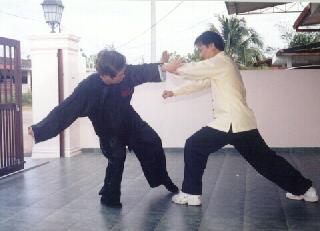
A taming pattern of Choy-Li-Fatt kungfu. In Choy-Li-Fatt, attack and defence is typically performed in continuous waves to overwhelm single or multiple opponents.
Question 3:
Our Shaolin combat training, while being very effective for combat, also trains us to calmly and quickly make appropriate decisions. This has many applications outside of combat (negotiation, avoiding negative situations, etc). Since Choy Li Fatt was developed to be used for fighting en mass, could the mind-level benefits have even more application for today's modern, multi-tasking culture with stimulus coming from all directions at all times?
- Sifu Matt Fenton
Answer to Question 3:
"
You have highlighted a very important point. While our combat training makes us very effective in sparring or real fighting, we place more value on its daily non-combat applications, like being righteous and courageous as well as being able to make right and fast decisions in our work and play.
Your question is very interesting here, but unlike other questions, including your other question above, where my answers are based on classical records as well as empirical evidence we have directly experienced, the answer here is based on my speculation as there I have no classical records or practical experience in this case.
If all other things were equal, the mind-level training of Choy-Li-Fatt would be comparatively less applicable for today’s multi-tasking culture, compared to the mind-training of arts like Shaolin and Taijiquan. Please take note of the two terms “if all other things were equal” and “comparatively”.
In real life, all other things are not equal. Secondly, here we compare Choy-Li-Fatt to the greatest of martial arts, Shaolin and Taijiquan. If we compare to other martial arts like Wing Choon and Karate, the result would be different.
Your conclusion is probably based on the similarity of Choy-Li-Fatt’s handling of multiple attacks in combat and our modern culture of handling stimuli coming from all directions. The comparison, however, is invalid, and is due to confusing root with branch, or cause with effect.
Here the ability to handle multiple attacks in combat and multiple stimuli coming from all directions is the result, not the cause, of mental strength and mental clarity from mind-level training. The similarity or difference of the result, like the similarity of multiple attacks and multiple stimuli does not affect the quality of mental clarity and mental strength. It is the other way round. The methods to develop mental clarity and mental strength affect the ability in handling multiple attacks or stimuli as well as other performance.
As Choy-Li-Fatt is an external art, there are no special methods involving special postures or movements to develop the mind. But because we in Shaolin Wahnam are trained in mind development, we can transfer the necessary mind-development skills to Choy-Li-Fatt movements to do so. These movements are those geared for fighting multiple opponents.
On the other hand, in Shaolin Kungfu or Taijiquan, there are special methods for mind development, like One-Finger Shooting Zen and Cloud-Hands. If all other things were equal, the comparatively quiescent movements of One-Finger Shooting Zen and Cloud Hands are more cost-effective for mind development than the comparatively dynamic movements of Choy-Li-Fatt. Hence the mind-level benefits of arts like Shaolin and Taijiquan are more applicable than those of Choy-Li-Fatt in meeting today’s multi-tasking culture.
On the other hand, if we compare students learning Choy-Li-Fatt at the coming Winter Camp with most other students learning Shaolin Kungfu and Taijiquan elsewhere, our students will be more efficient in today’s multi-tasking culture. It is because our students train their mind in Choy-Li-Fatt, whereas other students do not train their mind in Shaolin Kungfu and Taijiquan. For example, our students having better mental clarity will understand the answer here, whereas many other students may not know what we are talking about.
"
With regards to lifting weights to train internal force, as well as just about any other activity, how does chi relate to the muscles? I know that large muscles can take a lot of energy to maintain, and that tense muscles can lock up chi. However, my western mindset tells me that muscles are a necessary part of moving. Is it possible to move without muscles? Does practicing Shaolin Kungfu cause one's body to have the optimal amount of muscle, not too much and not too little? Am I causing myself confusion by combining two different paradigms?
With regards to lifting weights to train internal force, as well as just about any other activity, how does chi relate to the muscles? I know that large muscles can take a lot of energy to maintain, and that tense muscles can lock up chi. However, my western mindset tells me that muscles are a necessary part of moving. Is it possible to move without muscles? Does practicing Shaolin Kungfu cause one's body to have the optimal amount of muscle, not too much and not too little? Am I causing myself confusion by combining two different paradigms?
-Matt
Sihing Matt,
I was wondering a similar thing today after two days of chopping firewood. I know I am stronger today than 5 and even 10 years ago when I made my living as a carpenter and laborer.
What amazes me is that I don't get sore (other than an old elbow issue). And I feel positively more effective (which is akin to the feeling of being stronger) at splitting difficult wood rounds at the end of day 2, as compared to the beginning of day 1.
As Choy Lee Fatt is a school of kung fu well-suited for self defense againt multiple assailants & your shaolin wahnam school also has methods used for this purpose in level 11 and 12 of the Shaolin Kung Fu Training Program, which are "Single Unarmed Against Multiple Unarmed" & "Single Unarmed & Armed Against Multiple Armed" respectively. How might the tactics and philosophies of Hoong Ka & Choy Lee Fatt differ comparitively when dealing with multiple opponents? What are the similarities? In one on one combat?
This is a quite long and illuminating answer. Especially recommended read for those interested both in the fighting and spiritual aspects of kungfu or other martial arts.
For the patriarchs of Choy-Li-Fatt -kungfu,
their art was internal
Question 4:
Since Choy Li Fatt was developed with combat in mind, and using external methods as a focus, are there any safeguards in place to prevent practitioners from becoming overly violent and aggressive (as seen in many Karate practitioners)?
- Sifu Matt Fenton
Answer to Question 4:
" Unlike internal arts, as an external art there are no in-built mechanisms in Choy-Li-Fatt to prevent practitioners from becoming overtly violent and aggressive.
This does not mean that Choy-Li-Fatt practitioners are violent and aggressive, or if they are not violent and aggressive at the start, they will become violent and aggressive as they progress. But if for any reasons, some Choy-Li-Fatt practitioners become violent and aggressive, there is nothing in Choy-Li-Fatt training to prevent, reduce or overcome the violent and aggressive feelings.
This is different in the case of internal arts. There are no factors in internal art training to make practitioners violent and aggressive. But if for other reasons, they start to become violent and aggressive, without doing other things but by just practicing their internal arts, they can prevent, reduce or overcome their violent and aggressive feelings. If they were already violent and aggressive in nature before practicing internal arts, their internal art training can reduce or overcome their violence and aggression.
On the other hand, some arts like much of the Karate, Teakwood, Boxing, Kick-Boxing and Muay Thai practiced today, aggravate violent and aggressive feelings. If these practitioners were not violent and aggressive before their practice of these arts, their training may make them violent and aggressive. If they are violent and aggressive, not only their training does not reduce or overcome their violence and aggression, but it also aggravates these emotions.
There are, therefore, three categories in this respect:
Martial arts that result in and aggravate violence and aggression.
Martial arts that do not result in violence and aggression but also do not prevent, reduce or overcome them if these emotions arise due to other factors.
Martial arts that do not result in violence and aggression and prevent, reduce or overcome these emotions if they arise due to other factors.
Why do different arts have different results in relation to violence and aggression? This is because of the different philosophy, nature and practice of these arts.
In arts like Boxing and Karate, the philosophy is to win at all cost, often without regard to the practitioners’ own health and safety. The nature of their training is to tense their muscles and work themselves up in a frenzy. In practice, they pay much attention to hitting their opponents, and little attention to their own self-defence. All this leads to an increase of violence and aggression.
In external arts like Choy-Li-Fatt, Wing Choon and Praying Mantis, the combat philosophy is safety first. Although many practitioners tense their muscles, they do not purposely work themselves up in a frenzy; they attempt to be as relaxed as possible. In practical fighting, they pay much attention to their own safety, knowing well that just one strike, on themselves or on their opponents, can be fatal. This does not lead to violence and aggression, but may not prevent, reduce or overcome these emotions if they arise.
In internal arts like Taijiquan and Baguazhang, their philosophy paces cultivation over combat in terms of priority. The nature of the arts is chi flow. Hence, not only the practice of these arts does not lead to violence and aggression, but also it will prevent, reduce or overcome violence and aggression if they arise due to other reasons.
In our school, however, we practice Choy-Li-Fatt as well as Wing Choon and Praying Mantis as internal arts. Will the Choy-Li-Fatt taught at the coming Winter Camp be like the orthodox Choy-Li-Fatt taught elsewhere today?
The answer is both yes and no. The forms are the same, but the way we practice and apply it, is very different from the Choy-Li-Fatt most students practice today. Most Choy-Li-Fatt students practice it as an external art, but we do so internally. Even when we leave aside the external-internal difference, most Choy-Li-Fatt students use Boxing and Kick-Boxing in their combat application, but we use typical Choy-Li-Fatt techniques.
But when we compare to what Choy-Li-Fatt masters practice, ours is the same. The masters started their Choy-Li-Fatt training as an external art, but over many years of dedicated training it has become internal. The difference, however, is in the time-frame. Our students at the Winter Camp course do not need to practice for many years. They would attain the internal aspect of Choy-Li-Fatt in just a few days.
As usual, some Choy-Li-Fatt practitioners and other people may be angry. Whether they are angry or happy that I have revealed some secrets that may benefit them, is their business, and we are not going to argue with them. The answer here is for you and our students in Shaolin Wahnam, as well as other people who believe in us.
"
As an art that specialises in mass combat and multiple attackers, it is said that Choy Li Fatt is relatively weaker in high-level individual fighting. Generally, is it correct to say that one who can handle multiple armed assailants would have no difficulty in dealing with even a skilled individual opponent?
- Sifu Zhang Wuji
Answer to Question 5:
"
The first statement is correct, but the second statement is not. Of course, the answer carries the condition that all other things were equal.
The core reason for both situations is that the philosophy, skills and techniques in fighting multiple attackers are different from those in fighting a skilful individual opponent.
Choy-Li-Fatt is geared towards multiple fighting where opponents are normally not of a high combat level. If they are of a high combat level, they would not, in fact do not want to, group together to attack one individual.
It is not just a sense of fairness. For a high-level fighter, fighting alone is more effective than helped by a group in defeating an opponent because the other group members often come into the path of his continuous attacks, or interfere with his combat tactics or strategies.
A skilful fighter fighting a group of attackers will choose long-reaching techniques as they are more effective than short-range techniques. On the other hand, long-reaching techniques are more exposed, but the group attackers, being of a low combat level, do not know how to exploit these weaknesses. Even if they knew, the skilful lone fighter would be able to neutralize them.
The situation is different when he fights with another high-level opponent. If he is used to long-reaching techniques in multiple combat and applies them on a high-level opponent in solo combat, he is exposing himself unnecessarily. He may be able to neutralize the counter-attacks of the high-level opponent, but this does not negate the fact that he is giving his opponent unnecessary advantages.
Moreover, while long-reaching techniques are useful in fighting multiple attackers, when fighting with just one opponent, short-range techniques are a better choice, even when we leave aside the question of exposure and even when the lone opponent is not of a high-level. For example, a short inch-punch is more effective in hitting an opponent than a long swinging fist.
On the other hand, a high-level exponent skilful in solo fighting may have much difficulty fighting in mass attack if he is not trained for the purpose. This is expressed in the kungfu saying, “seong kuen pat tik seai sau” (Cantonese), which means “two fists are no match against four hands”.
Such a situation was well illustrated in a special course a few years ago. Even our advanced practitioners were initially at a loss when facing multiple attackers. But once they had learnt some important strategies, they could handle multiple attackers easily – even when they used weapons. It was amazing to see the transformation that took place within an hour! You may have a glimpse of such a transformation if you make a search for the appropriate videos on my home page.
In this respect of solo fighting and multiple combat, Wing Choon and Choy-Li-Fatt are an interesting contrast. Wing Choon Kungfu is geared towards high-level solo combat, whereas Choy-Li-Fatt is geared towards fighting against multiple attacks. Even a high-level Wing Choon master may have difficulty when confronting multiple attackers, whereas a Choy-Li-Fatt master, unless he can make the necessary adjustment, will be in a comparative disadvantageous position meeting another high-level master. Hence, our Choe Family Wing Choon practiced in Shaolin Wahnam, which combines the best of Wing Choon and Choy-Li-Fatt, is an excellent answer to this intruding topic.
"
Dear Sifu and Shaolin Wahnam family, greetings from Oz. After 4 years I am finally writing my first post on the forum.
Happy Days :-D
My Question:
Sifu what specifically does one stand to attain from the Choy-Li-Fatt course, besides the obvious multi-opponent combat advantage and the opportunity to learn the form from an internal perspective. This is in relation to other styles already ingrained in Shaolin Wahnam.
I have heard that wearing gloves (like boxing, or MMA competitions) inhibits the flow of chi from one's strike into the opponent. Is this true? If there is truth to that statement, would Choy Li Fatt, being more of an external art and relying less on chi transmission, be more suited to competition fighting, where wearing gloves is required?
Here is a very interesting one regarding the apparently "exposed" nature of Choy-Li-Fatt attacks. Read on!
The throwing punch of Choy-Li-Fatt may seem exposed,
but with the right skills it can actually be very guarded against counter-attacks
Question 6:
Choy Li Fatt has many wide, swinging movements with straightened arms. Can these characteristic movements become technical disadvantages in combat since swinging movements take longer to arrive, telegraph the strike and may leave the exponent vulnerable to certain qinna attack?
- Sifu Zhang Wuji
Answer to Question 6:
"
Yes, if all other things were equal, these characteristic Choy-Li-Fatt movements leave the exponent in various disadvantageous positions, like what you have said. If both combatants are of equal skills, the one using these characteristic Choy-Li-Fatt movements would expose himself to the other person, irrespective o the latter’s style.
These disadvantages would be aggravated if the other combatant is of a higher level. On the other hand, if the Choy-Li-Fatt exponent is more skilful, and especially if he has powerful arms, he would rain his swinging attacks on his opponent.
I vividly remember teaching “Three Rings Round the Moon” in a Shaolin Tantui class. These “Three Rings” movements are similar to long-range movements of Choy-Li-Fatt. An exponent swings his two strong arms, like iron rods, systematically in high speed at an opponent.
It would be difficult for the opponent to defend himself. If he tries to block a powerful, fast swinging arm, his arm may be broken. Even if he succeeds in blocking or warding it off, the next powerful, fast swinging arm would hit his head or body, followed continuously by non-stop powerful swinging arms.
If the opponent tries to counter with a pinch or a kick, the exponent’s swinging arms would rain on the opponent’s arm or leg as well as head or body. Trying to use felling techniques or qinna would be worse. Continuously swinging arms would rain on the opponent before he could even position himself for the felling or qinna counter.
If the opponent retreats, the exponent would swing his powerful arms, like the blades of a fast-moving electric fan, on him. It is difficult for the opponent, if he is not well trained, to respond such fast, powerful Choy-Li-Fatt attacks.
Yet, when everyone was overwhelmed by such fast, powerful swinging attacks at the Tantui course, I demonstrated some sophisticated counters, and the attacker had no chance at all to respond. The same techniques and skills can be applied to Choy-Li-Fatt attacks.
On the other hand, a Choy-Li-Fatt master would be able to counter effectively if an opponent tries to exploit such Choy-Li-Fatt swinging attacks. In other words, the Choy-Li-Fatt master would turn the tables around. The secret is body-movement.
In the coming Choy-Li-Fatt course at the Winter Camp, I shall first show how to use these formidable Choy-Li-Fatt movements. Next, I shall show how to counter these formidable movements. Then I shall show how to turn the tables around against the sophisticated counters. It is going to be very interesting.
"
This next one sheds some light on how Choy-Li-Fatt was originated, and also on how our schools kungfu has developed. Enjoy!
An old photograph of Fatt-Ka (Fut Gar) practitioners
Question 7:
How has Choy Li Fatt evolved since its conception? Does it have techniques, methods or tactics that are truly unique or is it more a specialization within southern Shaolin Kungfu?
- Tapio Raevaara
Answer to Question 7:
" I believe the First Patriarch of Choy-Li-Fatt Kungfu, Chen Harng, did not set out to invert a new style of kungfu. As he had learnt form three Shaolin masters, namely Choy Ah Fook, Li Yau San and the Venerable Cheng Chao, he spontaneously combined the best of these three styles in his training, which resulted in Choy-Li-Fatt.
This is like what is happening in our school today. I did not consciously pick patterns from the kungfu of Sifu Ho Fatt Nam and Uncle Righteousness and combined them to invent Wahnam Kungfu. In my training I spontaneously selected the best of what I had learnt from my two masters without a conscious effort to combine the two styles. I also selected the best from the Wuzu Kungfu and Wing Choon Kungfu I had learnt from my other two masters, Sifu Chee Kim Thong and Sifu Choe Hoong Choy. We call our style Shaolin Kungfu. It is only other people who call it Wahnam Kungfu.
The answer to whether Choy-Li-Fatt has techniques, methods or tactics that are unique, or is it a specialization within Southern Shaolin is “yes” and “no”.
On the whole, Choy-Li-Fatt is unique. It is different from Choy-Ka Kungfu, Li-Ka Kungfu and Fatt-Ka Kungfu, from which it evolved. In other words, if a group of practitioners perform Choy-Ka Kungfu, Li-Ka Kungfu, Fatt-Ka Kungfu and Choy-Li-Fatt Kungfu, an informed observer can tell which is which.
Yet, all the movements in Choy-Li-Fatt Kungfu can be found in Choy-Ka Kungfu, Li-Ka Kungfu and Fatt-Ka Kungfu. Actually most of Choy-Li-Fatt patterns are from Fatt-Ka Kungfu, which in turn was evolved from Lohan Kungfu. Chen Harng did not invent new patterns to compose Choy-Li-Fatt. It is an example of the whole is more than its parts.
We can find an interesting parallel in our school. The Shaolin Kungfu we practice in Shaolin Wahnam is quite different from the Shaolin Kungfu practiced at the southern Shaolin Temple in Quanzhou (which I learned from Sifu Ho Fatt Nam), and also different from the second southern Shaolin Temple on the Nine-Lotus Mountain (which I learned from Uncle Righteousness). Yet, the Shaolin patterns we practice in Shaolin Wahnam are taken from the Shaolin patterns at the two Shaolin Temples at Quanzhou and Nine-Lotus Mountain.
There is a third important influence in the Shaolin Kungfu we practice, and it is from Taijiquan. Our Shaolin Kungfu is more internal and more flowing than that at Quanzhou and Nine-Lotus Mountain. Nevertheless, Taijiquan evolved from Shaolin.
"
This is Grandmaster Wong's first answer in "Kungfu Against Other Styles" -series. There's some excellent tidbits below regarding the genesis of the Shaolin arts.
There are still openings for questions – take the opportunity!
Question 1:
In the formative years of kungfu at the Shaolin temple, were any patterns learned from visiting martial artists, or did Shaolin kungfu develop completely independently from other martial arts?
- Sifu Charles Chalmers
Answer to Question 1:
" Shaolin Kungfu was (and still is) not only a source but also a receptacle for many other martial arts. While it provided inspiration and material for other arts, it also received their best from them. This process of giving to and taking from other martial arts have continued from its formative years to the present time.
The first source of Shaolin Kungfu was the Eighteen Lohan Hands, taught by Bodhidharma, from which the Eighteen Lohan Fist, the prototype of Shaolin Kungfu, developed. The Eightten Lohan Hands probably came form yoga exercises practiced by Bodhidharma in India.
Generals who retired to the Shaolin Temple for spiritual cultivation brought with them their martial arts, which greatly enriched Shaolin Kungfu. They introduced many classical weapons as well as military strategies to Shaolin. These generals might also have introduced the Horse-Riding Stance.
From Taoist masters Shaolin Kungfu learned the Small Universe and the Big Universe. While these two excellent chi kung exercises never became the principle training methods in the Shaolin Temple, many Shaolin masters practiced and valued them highly.
The Mongolians brought their famous wrestling, which greatly enriched Shaolin felling techniques and floor work.
Influences from other martial arts are not necessarily always beneficial. Karate, which owed much of its material to the Shaolin source, revived free sparring in Shaolin Kungfu at a time when it was at its worst decay.
Taekwondo, which also owed much of its material to Shaolin, brought in high kicks. Its influence, especially after Bruce Lee had made kungfu well known in the West, became so pervasive that for a time many people consider how good a persons’s kungfu was by how high he could kick!
The influence of Western Boxing Siamese Boxing is wide-spread. Today, when they spar, most Shaolin practitioners, indeed most martial artists of any style, would bounce about and punch and kick like Western and Siamese Boxers. The influence is so complete that nowadays when one mentions “san da”, the image is that of kungfu practitioners with boxing gloves fighting like Boxers in a boxing ring, forgetting that the term actually means free sparring using typical kungfu forms.
This giving-to and taking-from process of Shaolin Kungfu is interestingly manifested in our school in relation to Taijiquan. Taijiquan originated from Shaolin Kungfu. In our school, Taijiquan was first taught to our students to meet expedient needs modelling on the Shaolin syllabus. In return, Shaolin Kungfu in our school has benefited much form Taijiquan, like graceful continuous movement, the flow method of internal force development, and the integration of form, energy and mind.
"
We process personal data about users of our site, through the use of cookies and other technologies, to deliver our services, personalize advertising, and to analyze site activity. We may share certain information about our users with our advertising and analytics partners. For additional details, refer to our Privacy Policy.
By clicking "I AGREE" below, you agree to our Privacy Policy and our personal data processing and cookie practices as described therein. You also acknowledge that this forum may be hosted outside your country and you consent to the collection, storage, and processing of your data in the country where this forum is hosted.

 Tweet
Tweet





Comment