Announcement

Collapse
No announcement yet.

Hoong Ka and Iron Wire -discussion

Collapse
X
 
  • Filter
  • Time
  • Show
Clear All
new posts

  • Hoong Ka and Iron Wire -discussion

    Dear all,


    As a prelude to the upcoming Iron Wire-course, I would like to initiate discussion on Southern Shaolin Kungfu, specifically Hoong Ka and its "Iron Wire" set, but also the "Taming the Tiger" -set.


    Since Hoong Ka is a very prominent part of Southern Shaolin - one that is intimately related to the kungfu taught in our Wahnam school - this discussion offers a good opportunity for Wahnam students of all levels to increase their understanding of Shaolin Kungfu through learning more about Hoong Ka.

    I will start from the background and basic characteristics of Hoong Ka in general, and then focus on "Iron Wire" and "Taming the Tiger" sets in particular, by compiling information found at Sifu's invaluable Q&A -section. From there, we can move on into application and benefits.

    Both Wahnam students and our respected visitors are invited to jump in at any point to take part in the discussion; especially visiting practitioners of other schools in the Hoong Ka lineage are welcomed with open arms to share their experiences and thoughts on practising this great art.


    Best wishes,
    Markus Kahila
    Shaolin Nordic Finland

    www.shaolin-nordic.com


  • #2
    Hoong Ka or Southern Shaolin?

    What is Hoong Ka?


    "
    Hoong Ka is Southern Shaolin. Much of the Shaolin Kungfu I teach is the Hoong Ka Kungfu I learned from Uncle Righteousness.


    The two most famous kungfu skills of Hoong Ka are tiger-claw and no-shadow kicks. Tiger-claw depends on internal force, and no-shadow kicks on tactics and speed. There is a lot of internal work in Hoong Ka Kungfu. Hoong Ka Kungfu places great importance on "chiat ma" or stance training, and stance training is no muscle work, it is a training of energy and mind.

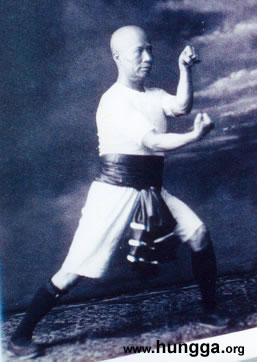
    It is illuminating that from their photographs it is clear that two of the most famous Hoong Ka masters of recent times, Wong Fei Hoong and Lam Sai Weng, dd not have big muscles. They had a small "drum" at their belly, which indicated the source of their tremendous internal force, but which muscle-loving persons like body builders would not like to possess.

    The Hoong Ka Kungfu that I learned from Uncle Righteousness and also from Sifu Ho Fatt Nam, did not involve muscle work like body-building and weight-lifting, though we sometimes used weights as a supplements, and accordingly the Hoong Ka Kungfu that I teach to my students now focuses more on chi cultivation.
    "
    - by Grandmaster Wong Kiew Kit

    Hoong Ka Master Lam Sai Weng

    History of Hoong Ka


    "
    The first patriarch of Hoong Ka Kungfu was Hoong Hei Khoon. He was an outstanding exponent of southern Shaolin Kungfu, which he spread in Guangdong Province. Hoong Hei Khoon learned Southern Shaolin Kungfu from the Venerable Chee Seen, who was the first patriarch of Southern Shaolin. Today many people call the style of kungfu passed down by Hoong Hei Khoon, or by his junior classmate, Lok Ah Choy, as Hoong Ka Kungfu.

    Many people think that Hoong Hei Khoon was the founder of Hoong Khuen or Hoong Ka Kungfu. This, however, is a mistaken concept! Actually there was no founder for Hoong Ka Kungfu. Hoong Ka Kungfu is another name for Southern Shaolin Kungfu since the burning of the Shaolin Temple during the Qing Dynasty. "Hoong Ka" is a modern term; even as recent as Lam Sai Weng's time, which was about 50 years ago, what is now called Hoong Ka by many people was then called Shaolin. The reason was that Shaolin disciples did not use the term “Shaolin” so as to avoid the pursue of the Qing government.

    Although Hoong Ka Kungfu is named in honour of Hoong Hei Khoon, most of Hoong Ka exponents today are descended from the lineage of Luk Ah Choy. Luk Ah Choy's lineage produced Wong Fei Hoong, who lived from 1847 to 1924 which was at the end of the Qing Dynasty and the beginning of the Republican period in China. Wong Fei Hoong was so well known that he was called the "Tiger after the Guangdong Ten Tigers". His disciple, Lam Sai Weng, brought his style of kungfu to Hong Kong, where it spread to various parts of the world.
    "
    - by Grandmaster Wong Kiew Kit

    For our lineage of Southern Shaolin, please see Sifu Mark Blohms excellent thread here.


    The above texts are compiled from the following sources:

    A selection of answers provided by Sifu Wong Kiew Kit to questions asked by the public on Shaolin Kungfu, Chi Kung, Taijiquan and Zen

    A selection of answers provided by Sifu Wong Kiew Kit to questions asked by the public on Shaolin Kungfu, Chi Kung, Taijiquan and Zen

    A selection of answers provided by Sifu Wong Kiew Kit to questions asked by the public on Shaolin Kungfu, Chi Kung, Taijiquan and Zen


    A selection of answers provided by Sifu Wong Kiew Kit to questions asked by the public on Shaolin Kungfu, Chi Kung, Taijiquan and Zen


    Please see the links for more detailed information.


    Best wishes,
    Last edited by Andrew; 11 November 2009, 08:28 AM. Reason: User request
    Markus Kahila
    Shaolin Nordic Finland

    www.shaolin-nordic.com

    Comment


    • #3
      hello,

      here is a link to a small article i have written about our version of "taming the tiger":


      demonstrated here by Lam Saiwing jou si:


      (just a quick note: on the first picture above is not Wong Feihung, but one of his sons. unfortunatelly, there is no photo of Wong Feihung)
      Pavel Macek Sifu

      Practical Hung Kyun 實用洪拳

      sigpic

      Comment


      • #4
        Dear Pavel,


        Thank you kindly for the articles / correction - I'll be sure to edit the photograph above!


        Next installment coming tomorrow.


        Best wishes,
        Markus Kahila
        Shaolin Nordic Finland

        www.shaolin-nordic.com

        Comment


        • #5
          Hoong Ka in Wahnam school Kungfu

          "
          "Iron Wire Set” or “Iron Thread Set” (“Tit Sin Khuen”) is one of the three treasures of Hoong Ka Kungfu, especially from Wong Fei Hoong's lineage, the other two being “Kung Tze Fok Fu Khuen” (“Taming the Tiger Set”) and “Fu Hiok Seong Yin Khuen” (“Tiger-Crane Double-Form Set”). It was said that if one mastered these three sets (including their internal force and combat application, of course), he could be invincible.

          As the three famous kungfu sets of Wong Fei Hoong were “Taming the Tiger”, “Tiger-Crane” and “Iron-Wire”, many people thought these were the only orthodox Hoong Ka sets. This is not so. When I was learning kungfu from Uncle Righteousness in Penang (in Malaysia) in the 1950s, there was a famous Hoong Ka master named Ng Siew Hoong, who was respectfully known as Hoong Pak, or “Elderly Uncle Hoong”. His famous Hoong Ka sets were “Four Gates” and “Tiger Claws”.

          I also learned “Four Gates” from my sifu, Sifu Ho Fatt Nam, and “Essence of Shaolin” from my sifu, Uncle Righteousness. My “Four Gates” is different from that taught by Elderly Uncle Hoong, but my “Essence of Shaolin” is the same as that taught by the other old Hoong Ka master, though there was no connection between that old master and Uncle Righteousness. “Four Gates” is reputed to be the fundamental set taught at the open square in the southern Shaolin Monastery, and “Essence of Shaolin” was the most advanced set taught to selected disciples.
          by Grandmaster Wong


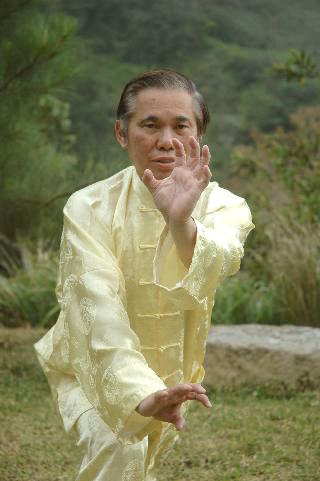
          Sifu Wong demonstrating the famous Double Tiger Claws of Southern Shaolin Kungfu.

          This pattern is known as "Hungry Tiger Catches Goat", and is from the "Tiger-Crane Set" of Uncle Righteousness lineage.


          “Fierce Tiger Descends Mountains” (Mang Fu Ha San) shown in my webpage is not a classical set passed down by masters; it is a set consisting of various combat sequences composed by me. I choose the name “Fierce Tiger Descends Mountains” because it expresses well the philosophy, spirit and skills embodied in this set where the Single Tiger Claw and the Double Tiger Claws are used in qin-na (gripping) techniques. Many of the patterns in the set “Mag Fu Ha San” are taken from my Hoong Ka system, although we usually refer to our Hoong Ka system as Southern Shaolin.

          Although “Fierce Tiger Descends Mountain” is not at our basic stage but at our intermediate stage of training, it is also a result of our sparring practice. After this, we move to classical sets like “Four Gates”, “Five Animals”, “Tiger-Crane” and “Dragon and Tiger” at our intermediate stage, and to other classical sets like “Eighteen Lohans”, “Flower Set” and “Dragon's Strength” at our advanced stage. At whatever stages, set practice is a means, and not an end, of our kungfu training.
          "
          by Grandmaster Wong


          Text compiled from the following links:

          http://www.shaolin.org/answers/ans03b/sep03-2.html
          http://www.shaolin.org/answers/ans03b/dec03-2.html


          For an excellent overview into Grandmasters sets he learned from different Sifus:

          http://www.shaolin.org/answers/ans06a/apr06-2.html


          Next installment: Iron Wire set!


          Best wishes,
          Markus Kahila
          Shaolin Nordic Finland

          www.shaolin-nordic.com

          Comment


          • #6
            The Iron Wire set: Force

            An excellent picture series of the Great Hoong Ka Master Lam Sai Weng performing the Iron Wire set is kindly shared at the Lam Ga Hung Kyun website.

            For a video of Grandmaster Wong performing a selection from the set, please visit here.


            .


            "
            “Theit Seen Khuen” or Iron-Wire Set is considered by many as the most advanced kungfu set in Hoong Ka Kungfu.

            “Iron Wire Set” was reputed to be invented by the foremost of the Ten Kwangtung Tigers, Tit Kiew Sam. His “bridges” or arms were so powerful that when he placed them in front as in “Golden Bridge”, two buffaloes pulling at each side could not pull them apart. It was recorded that he could let six able-bodied adults hang on each arm, yet walked for over a hundred steps.

            How did Thit Kiew Sam train to have such powerful arms? It was not through lifting weights and other mechanical means, but through practicing “Thit Seen Khuen”, or the “Iron Wire Set”. Thit Kiew Sam taught this set to Lam Fook Seng, who in turn taught it to Wong Fei Hoong, who then taught it to Lam Sai Weng.
            "
            by Grandmaster Wong


            Hoong Ka master Lam Sai Weng performing "Double Inch Bridges"


            "
            The main principle in the internal force training of “Iron Wire Set” is to “consolidate” energy into essence. As a rough analogy it is like converting a stream into a glacier. The force developed is “hard” and internal, in contrast to “soft” and internal as in Taijiquan.

            In channeling chi or energy, appropriate sounds are used, such as “herit”, “ho” and “ya”. These sounds also help to strengthen various internal organs.

            A common mistake some practitioners make is to perform the qi channeling and jing consolidating exercise in “Iron Wire Set” as isometric exercise. They are quite different. In qi channeling and jing consolidating, the muscles are relaxed. What is involved is the training of energy, essence and mind.

            In isometric exercise, the muscles are tensed, and the energy and mind are usually blocked. What is involved is physical exertion. Performing “Iron Wire Set” as isometric exercise can be harmful, whereas performing the set as an energy management exercise brings good health and vitality.


            It is a common mis-conception, even among some advanced practitioners, that internal force is necessarily soft. Just as external force can be soft, internal force can also be very hard.

            "Hard" and "soft" here, which are poor translations of "gang" and "rou" in Chinese, are different from what many Westerners regard as hard and soft. "Soft" here can be very powerful. An empty hose is limp. We can make it taut by lining its interior with strong iron wires. This is a rough analogy of a person's arm made taut by tensing his muscles. If we support the hose and chop it with an axe, we may break it into two.

            Instead of using strong iron wires to make the hose taut, we may do so by filling it with running water. This is a rough analogy of a person's arm made taut by powerful flowing energy. If we support the hose and chop it with an axe, the axe would be bounced away. This water hose full of running water is a good illustration of hard internal force. If we smash the hose onto some bricks, it can easily break the bricks.

            Now we have a live wire connected to a power point. When we switch on the power, it examplies soft internal force. If we hit the wire onto some bricks we cannot break the bricks even when the power is on. But if we connect it to an opponent, we can cause tremendous damage.
            "
            by Grandmaster Wong


            The above texts are compiled from the following sources:

            A selection of answers provided by Sifu Wong Kiew Kit to questions asked by the public on Shaolin Kungfu, Chi Kung, Taijiquan and Zen

            A selection of answers provided by Sifu Wong Kiew Kit to questions asked by the public on Shaolin Kungfu, Chi Kung, Taijiquan and Zen


            Please visit the links for more detailed information.


            Coming next: Iron Wire bridge force!


            Best wishes,
            Markus Kahila
            Shaolin Nordic Finland

            www.shaolin-nordic.com

            Comment


            • #7
              Iron Wire Bridge Force

              "
              “Thit Seen Khuen” is an advanced kungfu set to train internal force, not just for combat efficiency but also for health, vitality and longevity. It also makes the body tough (but not massive or muscular), and the mind sharp and clear.

              Through his generosity, Lam Sai Weng recorded this invaluable set for posterity in his classic, “Thit Seen Khuen” (“Iron Wire Set”), penned by his disciple Chu Yu Chai. As it was the custom amongst kungfu masters in the past, although a lot of information was recorded, this classic was concise, which means that only those with background knowledge could understand the information.

              The Twelve Bridges in Hoong Ka Kungfu refer to twelve different ways of using the forearms in combat. It is essential to back up these twelve techniques with force. Hence there are also "twelve different kinds of force" that correspond to these twelve techniques.
              "


              Hoong Ka master Lam Sai Weng performing
              the Iron Wire set pattern "Clap Wood Fists",
              which is useful for developing "hard" force


              "
              These twelve types of “bridge force” are expressed in the following poetic couplet (in Cantonese):
              Kong yow pik cheit fun ting chuin
              Tai lau wan chai ding thien khuen


              Literally translated word by word, they are as follows;
              Hard soft press straight separate stable inch
              Lift keep circulate control match the cosmos


              As in most “poetic formulae” the words meaning nothing to the uninitiated. Briefly the meaning is as follows.
              • “Hard” and “soft” refer to whether the internal force used in the various techniques is “hard” or “soft”.
              • “Press” refers to pressing force on an opponent, as in continuous attacks.
              • “Straight” refers to force in a straight movement, like a thrust-hand attack.
              • “Separate” refers to force to dislodge from an opponent's grip or control.
              • “Stable” refers to force that immobilizes the opponent.
              • “Inch” refers to force executed in close quarters.
              • “Lift” refers to force to “float” an opponent's movement.
              • “Keep” refers to force that holds on to the opponent, like placing a hand on his to sense his intention.
              • “Circulate” refers to skill in channeling internal force to various parts of the body.
              • “Control” refers to force to control or subdue an opponent, like preventing him from moving away.
              • “Match” refers to the skill to co-ordinate different uses of force at the same time.
              • “Yhien khuen” refer to the two trigrams which represent “heaven” and “earth”, and figuratively mean the cosmos. This concluding phrase suggests that if one applies the various types of internal force well, he can handle any situations.
              "


              Grandmaster Lam Sai Weng demonstrating a pattern
              from the Iron Wire Set for developing "soft" force


              "
              To understand these “twelve bridges”, it is helpful to know two points. One, the difference is in their application, not in their nature. It is actually the same force, but used differently - the force in the use of the "lift" technique, for example, is different from that in the "circulate" technique. The difference, however, lies more in their application rather than their nature.

              Two, the classification into these “twelve bridges” is not exclusive or rigid. For example, if a particular pattern is used to train or apply hard force, it does not necessarily mean that the same pattern cannot be used to train or apply soft force. Or, if a force is hard, it does not mean that it cannot be soft too.
              "

              by Grandmaster Wong


              The above texts are compiled from the following sources:

              http://www.shaolin.org/answers/ans07a/may07-2.html
              http://www.shaolin.org/answers/sp-is...on-wire01.html

              Please visit the links for more detailed information.


              Next up: Bridge training in Hoong Ka!


              Best wishes,
              Markus Kahila
              Shaolin Nordic Finland

              www.shaolin-nordic.com

              Comment


              • #8
                This course is going to be awesome!
                "Take a moment to feel how wonderful it feels just to be alive."
                - Sifu

                Comment


                • #9
                  Bridges in Hoong Ka and other kungfu styles

                  "
                  Hoong Ka Kungfu is famous for its “bridges”, or powerful forearms.

                  “Asking Bridge” (“Men Kiu”), “Sticking Hands” (“Chi Sau”) and “Pushing Hands” (“Tui Shou”) are some of the ingenious ways in Hoong Ka, Wing Choon and Taijiquan respectively to train combat skills. In these methods, two practitioners keep their forearms in contact, and engage in attacking and defending moves.

                  The techniques and tactics they use are quite different. Hoong Ka “Asking Bridge” is relatively hard, and focuses on sinking an opponent's bridges. The two practitioners move above in various stances.

                  Wing Choon “Sticking Hands” are relatively stationary, with both practitioners at the Goat Stance. Their hand movements are fluid and in circles, though attacks usually come in straight lines.

                  Taijiquan “Pushing Hands” is practiced mainly at the Bow-Arrow Stance. There are two modes, stationary which focuses on developing skills, and mobile which focuses on applying techniques.

                  Hap Ka, White Crane and Choy-Li-Fatt are famous for their arm techniques, as distinct from using fists, elbows, fingers or palms.
                  "


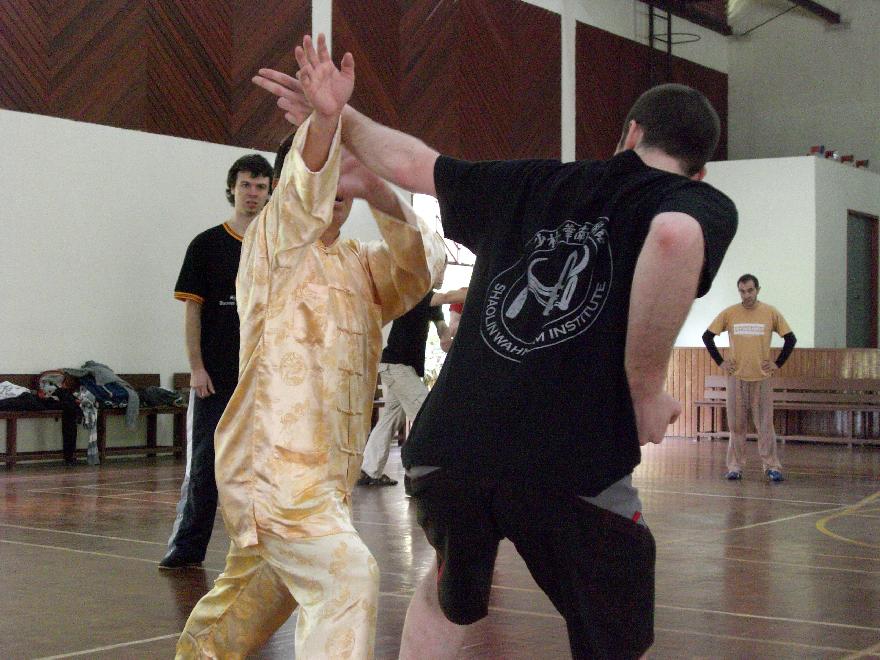
                  Sifu Jamie Robson's response to Grandmaster Wong's attack shown above
                  is an application of the skill of "Men Kiew" or "Asing Bridge" in Shaolin Kungfu


                  "
                  A famous combat principle in Hoong Ka as well as other styles of kungfu is "kiew lei kiew seong ko, mo kiew soon shui lau", which is "if there are bridges cross them, if there are no bridges flow with water". Basically it means that if the opponent attacks you, brush over his attack to counter-strike, if contact is broken flow in with his movements. This Hoong Ka principle is similar to the Wing Choon principle "loi low hui soong, liet sau jiet joong", which is "retain arrival send departure, hands disconnected straight enter".

                  These two principles represent the crystallized wisdom of past masters in their use of tactics derived from centuries of actual fighting, passed down to us in secret transmission. Understanding just these two principles will enable us to have many different variations to suit different combat situations whereby we can have certain advantages over our opponents.

                  In my own experience, I have used just these two principles to effectively handle countless combat situations in both friendly sparring and actual fighting. These are just two of many, many principles. This shows how rich kungfu is, and how saddening to see kungfu students as well as some masters discard their kungfu for kickboxing in their sparring.
                  "

                  by Grandmaster Wong


                  The above texts are compiled from the following sources:

                  http://www.shaolin.org/answers/ans04a/apr04-3.html
                  http://www.shaolin.org/answers/ans07a/may07-2.html

                  Please visit the links for more detailed information.


                  Best wishes,
                  Markus Kahila
                  Shaolin Nordic Finland

                  www.shaolin-nordic.com

                  Comment


                  • #10
                    Conclusion

                    The above article concludes our short overview into the Iron Wire-set and Hoong Ka kungfu in general.


                    As always, comments and discussion is most welcome - before as well as after the "Iron Wire" -course that is due in a few weeks.


                    Looking forward to seeing you there!


                    Best wishes,
                    Markus Kahila
                    Shaolin Nordic Finland

                    www.shaolin-nordic.com

                    Comment


                    • #11
                      Thanks Sifu Markus!

                      Thank you for all links You have given us. Especially this site www.lghk.org was super!!! All old photographs were outstanding!

                      Liang Fu

                      Comment


                      • #12
                        oh, thank you! more stuff hopefully coming soon - old photographs, articles, some videos, just takes time to edit it all and translate

                        all the best in your training!
                        Pavel Macek Sifu

                        Practical Hung Kyun 實用洪拳

                        sigpic

                        Comment


                        • #13
                          Since the Iron Wire set will be taught at Shaolin Wahnam Summer Camp 2010, this is a good time to revive this thread!

                          Compiled here you can find a lot of information on Hoong Ka kungfu and the Iron Wire set, both of which are considered an important part of Southern Shaolin heritage.


                          To start things up, I'd like to invite participants from Grandmaster Wong's Iron Wire course that was held in January 2010 to share their experiences:
                          • What has daily practice of the Iron Wire set been like?
                          • What kind of benefits have you experienced?

                          Looking forward to hearing from you!


                          Best wishes,
                          Markus Kahila
                          Shaolin Nordic Finland

                          www.shaolin-nordic.com

                          Comment


                          • #14
                            Iron Wire

                            Hi,

                            I have been practising the Iron Wire set since Grandmaster's Course this years Winter Camp.

                            I am still working a lot with form itself,but I have noticed that after I have done my Iron Wire set and start to do combat sequenses, my arms are much more solid and firm in punches like Black Tiger.

                            I am looking forward to get all the benefits of this exellent Art.

                            BR,
                            Marko

                            Comment


                            • #15
                              I would absolutely love to learn this set, the benefits of it from what I have read are exactly what I would look for in high level martial arts.
                              Shaolin Wahnam California

                              Comment

                              Working...
                              X